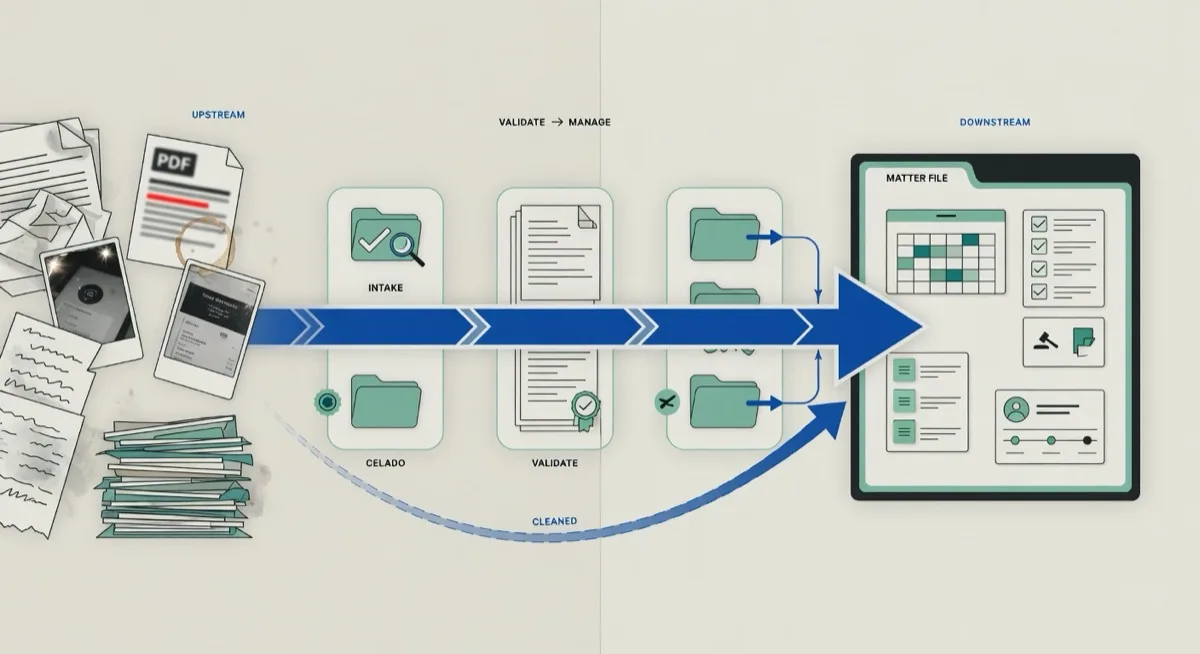
Most law firms do not have a software problem. They have a workflow ownership problem.
That is why the “Filevine versus GetDocs” question is usually the wrong question. A case management system and a document intake layer should not be wrestling for the same chair. If they are, the process was designed backward.
Filevine is built to manage matters, tasks, notes, teams, deadlines, and case data. GetDocs is built to collect, organize, validate, and route client documents before staff waste time chasing the same bank statement for the fourth time. One is the case file. The other is the document front door.
Used correctly, they are complementary. Used incorrectly, either one can become an expensive storage closet with a login screen.
The clean split
| Workflow job | Filevine | GetDocs |
|---|---|---|
| Matter system of record | Strong fit. Case notes, tasks, deadlines, staff workflow, project-level data. | Not the primary job. GetDocs should feed clean document status and files into the matter workflow. |
| Client document collection | Possible through configured workflows, forms, links, and integrated tools. | Primary fit. Client-facing upload flow, document checklist logic, validation, and review queues. |
| Document quality control | Usually staff-driven unless the firm has built extra automation around it. | Primary fit. Validate category, completeness, legibility, sensitive fields, and missing items upstream. |
| Attorney/paralegal work management | Primary fit. | Support layer. It should reduce staff chase work, not replace matter management. |
Where firms get it wrong
The mistake is forcing a case management platform to behave like a purpose-built client portal, quality control desk, reminder engine, and document triage team all at once.
That creates a familiar mess:
- Clients upload documents in the wrong place.
- Staff rename files by hand.
- Blurry statements hit the matter file before anyone catches them.
- Client and spouse records get mixed together.
- Paralegals become full-time document chasers instead of case movers.
At that point, the firm is not “automated.” It is just manually operating inside more expensive software.
The operating rule
Keep messy client behavior upstream. Let the document intake layer catch, label, validate, and escalate the mess before it reaches the matter system.
What Filevine brings to the table
Filevine’s strength is case management. It gives firms a configurable operational core: projects, contacts, tasks, deadlines, notes, document references, team assignments, and matter workflows. Filevine also publishes integration materials and marketplace options for connecting Filevine activity with outside systems.
That matters because a modern firm does not run on one monolithic application. Intake, phones, document collection, payments, e-signature, calendaring, and reporting all need to move data without staff copying and pasting like it is 2004.
The question is not “Can Filevine connect?” The better question is: what should be allowed into Filevine, and when?
What GetDocs brings to the table
GetDocs is aimed at the ugly part of legal operations: getting clients to submit the right documents, in the right format, with enough quality that a human can actually use them.
For bankruptcy, family law, immigration, and any practice area with heavy document burden, that is not a minor convenience. It is the work. A missing paystub, partial bank statement, or bad photo can stall the whole matter. The client thinks they “sent everything.” Staff knows they did not. Everyone loses another day.
GetDocs sits before the case management system and turns vague client uploads into a cleaner operational package: required document lists, reminders, status visibility, quality review, and routing. That means the case management system receives better inputs.
The best architecture: validate before you file
The right workflow looks like this:
- Lead or client is created. The firm opens a matter or intake workflow in the case management system.
- Document checklist is triggered. The client gets a simple collection experience instead of a scavenger hunt through email threads.
- GetDocs validates uploads. The system checks whether files are present, readable, categorized, and ready for review.
- Exceptions go to staff. Humans handle edge cases instead of babysitting every normal upload.
- Clean status and files move downstream. The matter workflow gets usable data, not a junk drawer.
This is how software should behave: one system owns the matter, one system owns document collection, and the integration passes clean signals between them.
When they might overlap
There is overlap at the edges. Filevine can support document-related workflows. GetDocs can hold client document status and review state. But overlap does not automatically mean competition.
A phone can take pictures. That does not make it a scanner for a 300-page bankruptcy petition package. Use the right tool for the job, unless your goal is to turn your staff into unpaid middleware.
What to verify before connecting them
Before a firm connects Filevine and GetDocs, it should answer five questions:
- System of record: Which fields live permanently in Filevine?
- Document truth: Does the firm want raw uploads, reviewed uploads, or only approved document packages downstream?
- Permissions: Which users and roles can create matters, update records, or attach documents?
- Audit trail: Where should the firm record who uploaded, reviewed, rejected, or approved each document?
- Failure handling: What happens when a client uploads the wrong file, an integration fails, or a required document is missing?
Those decisions matter more than the logo on the integration diagram.
The practical answer
GetDocs is not a Filevine replacement. Filevine is not automatically the best place to collect and validate every client document. The smart move is to let each system do the job it was built to do.
Filevine should run the matter. GetDocs should clean up the document chaos before it gets there.
If your firm already uses Filevine, the opportunity is not to rip it out. The opportunity is to stop using high-value staff as document chasers. Put a purpose-built intake layer in front of the matter system and let the paralegals go back to moving cases.
Want the clean version of this workflow?
Iron Noodle designs intake and document workflows for law firms that need fewer loose ends, faster follow-up, and cleaner case files.
Book ConsultationSources reviewed
This article avoids unsupported claims about a native Filevine/GetDocs integration. It is based on public product and integration materials from the vendors.